
Know a legend? Nominate them. Self-nominations welcome, modesty optional. Tell us who

Get featured
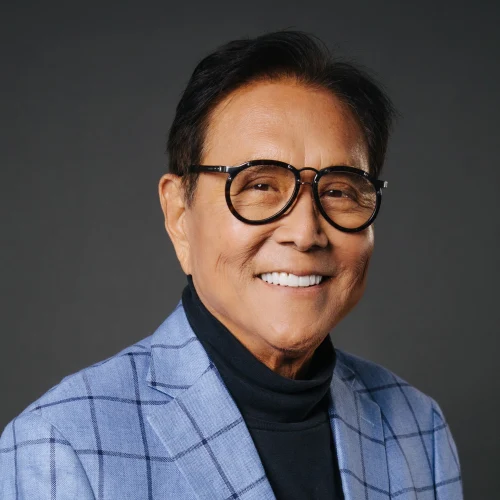
Robert Kiyosaki
Flag of the United States USA

Leader profile

Robert Kiyosaki

Also known as Robert Toru Kiyosaki

American businessman and author of Rich Dad Poor Dad (1997), the bestselling personal finance book, and founder of the Rich Dad Company.

Profession

Author, Businessman, Investor, Public speaker

Known for

Financial literacy, Personal finance, Real estate investing, Entrepreneurship, Assets and liabilities, Cash flow, Passive income, Debt and leverage, Gold and silver, Bitcoin, Taxes

Born

April 8, 1947

Died

Birthplace

Hilo, United States

Based in

Hawaii

Nationality

USA

Who is Robert Kiyosaki?

Robert Toru Kiyosaki, born on 8 April 1947 in Hilo, Hawaii, is an American businessman and author best known for Rich Dad Poor Dad (1997), co-written with Sharon Lechter. He founded the Rich Dad Company, which sells personal finance education through books, games, seminars and media.

His books contrast two father figures: his own father, an educator he calls “Poor Dad”, and a best friend’s entrepreneurial father he calls “Rich Dad”. Kiyosaki argues that schools do not teach financial literacy and that wealth comes from owning income-producing assets, such as businesses and real estate, rather than relying only on a salary and savings.

Before his writing career he graduated from the US Merchant Marine Academy, flew helicopter gunships for the Marine Corps in the Vietnam War, sold copiers for Xerox and ran several businesses, some of which failed.

His ideas have been widely popular but also heavily criticised, with critics pointing to a lack of concrete advice, the sales tactics of Rich Dad seminars and the 2012 bankruptcy of his company Rich Global LLC.

Why they matter

Robert Kiyosaki is one of the most widely read personal finance authors in the world. Rich Dad Poor Dad had sold nearly 40 million copies by 2017 and helped popularise ideas such as assets versus liabilities, passive income and financial literacy outside formal schooling.

His CASHFLOW board game, books and Rich Dad Radio Show podcast have built a large global following. In recent years he has strongly promoted gold, silver and Bitcoin and openly described using large amounts of debt to buy assets.

Financial journalists and broadcast investigations have criticised his advice as vague or risky and examined the practices of seminars sold under his brand, so his influence remains divisive.

Early Life and Education in Hawaii

Robert Toru Kiyosaki was born on 8 April 1947 in Hilo, in what was then the Territory of Hawaii, the eldest child of a Japanese American family. His mother, Marjorie, was a nurse, and his father, Ralph Kiyosaki, was an educator who was once appointed Hawaii’s superintendent of schools.

In 1970 his father ran unsuccessfully for lieutenant governor on the Republican ticket and lost his government job afterwards; he later invested his savings in an ice-cream franchise that failed. Kiyosaki presents him in his books as the highly educated but financially struggling “Poor Dad”.

Kiyosaki graduated from Hilo High School, from which he was nearly expelled because of poor grades. He describes the father of a childhood friend, a businessman he calls “Rich Dad”, as his mentor in money and investing, and this contrast became the basis of his later books.

Military Service and Post-War Ventures

In 1965 Kiyosaki entered the US Merchant Marine Academy at Kings Point, New York, graduating four years later as a deck officer. After sailing on Matson ships, he turned down a job with Standard Oil and joined the US Marine Corps as an officer.

He trained as a pilot and flew helicopter gunships during the Vietnam War, and was at one time based at Kaneohe Bay in Hawaii. His official biography says his military service ended in 1973; other accounts give later dates.

After leaving the Marines he chose sales and business rather than a salaried career, a decision he links to the lessons of his “Rich Dad”.

Early Entrepreneurial Pursuits

In 1977 Kiyosaki started Rippers, which marketed nylon and Velcro “surfer” wallets. The company later went bankrupt, as did a following business selling licensed rock band T-shirts. He also worked as a sales associate at Xerox until June 1978.

In the 1980s he became a motivational speaker in San Diego. In 1984 he and D. C. Cordova took over Money and You, a seminar course created by Marshall Thurber, and expanded it internationally to tens of thousands of students.

In 1993 the Australian Broadcasting Corporation’s Four Corners programme aired a critical report in which former participants described emotionally harsh methods. Kiyosaki called the report unfair and left the business in 1994. He has said that his business failures taught him more than formal study.

The Founding of Cashflow Technologies, Inc.

In 1997 Kiyosaki founded Cashflow Technologies, Inc., a holding company that owned and operated the Rich Dad brand and the CASHFLOW brand of educational games. He co-founded the Rich Dad Company with Kim Kiyosaki.

The companies publish his books, sell the CASHFLOW board and video games and license the Rich Dad name for seminars and courses. Much of the revenue comes from franchise-style arrangements in which independent operators run Rich Dad-branded seminars for a fee.

This structure allowed his message to scale from his own lectures to a global brand, and he has said his books serve as an advertisement for higher-priced seminars.

The Genesis of 'Rich Dad Poor Dad'

Kiyosaki’s first book, If You Want to Be Rich and Happy, Don’t Go to School?, appeared in 1993. His breakthrough came with Rich Dad Poor Dad, written with accountant Sharon Lechter and first self-published in 1997.

Written as a set of parables presented as autobiography, the book contrasts the advice of “Poor Dad”, who valued education, job security and saving, with “Rich Dad”, who stressed business ownership, investing and financial literacy. It explains concepts such as the difference between assets and liabilities and the importance of cash flow.

Kiyosaki promoted the book from self-publication to the bestseller lists. It has been translated into dozens of languages and had sold nearly 40 million copies by 2017, launching the wider Rich Dad series.

Expansion of the Rich Dad Brand and Financial Education

After Rich Dad Poor Dad, Kiyosaki published a long series of books, more than 26 in all, including Rich Dad’s CASHFLOW Quadrant (1998), Rich Dad’s Guide to Investing (2000) and Rich Dad’s Prophecy (2002). He co-wrote two books with Donald Trump, starting with Why We Want You to Be Rich (2006).

He created the CASHFLOW board game and video games to teach adults and children about assets, liabilities and passive income through play. The Rich Dad Company also offers courses, seminars and the Rich Dad Radio Show podcast.

Seminars branded as Rich Dad Education were run by licensed partners such as the Whitney Information Network, extending the brand into real estate, stock market and business training worldwide.

Investment Philosophy and Real Estate Focus

Kiyosaki teaches that financial independence comes from passive income generated by assets rather than from wages. He argues that a personal home is not an asset in this sense because it costs money each month rather than producing income.

Real estate is central to his approach. He advises buying property that produces positive cash flow and using “good debt”, or other people’s money, as leverage, along with the tax advantages of property ownership such as depreciation.

He also strongly promotes gold and silver, which he calls “God’s money”, and Bitcoin, and has said he holds more than one billion dollars in debt. Critics note that heavy leverage carries significant risk, and that Rich Dad seminars kept promoting real estate in 2006 and 2007, just before the US housing crash.

Critiques and Controversies Surrounding Kiyosaki's Teachings

Many financial commentators criticise Kiyosaki’s advice for relying on anecdotes rather than concrete, actionable steps, and for downplaying saving and diversified investing. His encouragement of debt-financed investing is also seen as unsuitable for many readers.

Seminars sold under his brand have faced scrutiny. In 2010 the CBC programme Marketplace and CBS News examined Rich Dad seminar tactics, and a Pittsburgh station, WTAE-TV, aired a critical report in 2013. He has also been named in a class action filed by seminar attendees.

In 2008 he settled a lawsuit with his former business partner and co-author Sharon Lechter. In August 2012 his company Rich Global LLC filed for Chapter 7 bankruptcy after a court ordered it to pay about 23.7 million dollars to The Learning Annex; the Rich Dad Company said it was a dormant entity and that Kiyosaki’s personal assets were not affected.

Watch Robert Kiyosaki speak

Frequently Asked Questions

Robert Kiyosaki is an American businessman and author, born on 8 April 1947 in Hilo, Hawaii. He is best known for the 1997 book Rich Dad Poor Dad, one of the best-selling personal finance books of all time.

Before his writing career he graduated from the US Merchant Marine Academy and served as a US Marine Corps helicopter pilot in the Vietnam War.

The book contrasts the money habits of two father figures. Its central idea is that assets put money in your pocket, while liabilities take money out, and that building wealth means acquiring income-producing assets such as businesses and real estate.

Kiyosaki also stresses financial education, understanding taxes, using debt to buy assets and thinking like an entrepreneur rather than relying only on a salary.

Kiyosaki’s ‘poor dad’ was his father, Ralph Kiyosaki, a highly educated educator who served as Hawaii’s superintendent of education. Kiyosaki says his ‘rich dad’ was the father of a childhood friend who became wealthy through business.

He has never publicly identified the ‘rich dad’, and some critics have questioned whether he was a real individual or a composite character.

The CASHFLOW Quadrant, from Kiyosaki’s 2000 book of the same name, sorts people by how they earn income: Employee (E), Self-employed (S), Business owner (B) and Investor (I).

He argues that financial freedom is more achievable in the B and I quadrants, where income comes from systems and investments rather than personal time.

Kiyosaki distinguishes between ‘good debt’, used to buy assets that produce more income than the debt costs, such as a cash-flowing rental property, and ‘bad debt’, used for consumer purchases.

In 2024 he said he personally had more than $1 billion in debt, mostly tied to real estate, presenting it as an example of this strategy.

Kiyosaki favours real estate and businesses, and is sceptical of saving cash and of conventional advice to hold mutual funds for retirement.

He has long promoted gold and silver, which he calls ‘God’s money’, and in recent years has also promoted Bitcoin. He frequently predicts market crashes, a habit his critics point to when assessing his forecasts.

CASHFLOW is a board game created by Kiyosaki to teach financial concepts. Players try to escape the ‘rat race’ by building passive income from assets until it exceeds their expenses.

Versions for adults and children, as well as digital editions, are sold through the Rich Dad Company.

Financial experts have criticised his advice as vague or risky, particularly on leverage. Seminars licensed under the Rich Dad brand were the subject of complaints and a 2010 CBC Marketplace investigation over high-pressure sales.

In 2012 his company Rich Global LLC filed for bankruptcy after being ordered to pay about $24 million to The Learning Annex in a lawsuit. His supporters credit him with making financial literacy popular with a wide audience.

Their work

Organizations, books and events

Organizations

The Rich Dad Company

Cashflow Technologies, Inc.

Rippers

Books

Rich Dad Poor Dad

Rich Dad’s CASHFLOW Quadrant

Rich Dad’s Guide to Investing

Why We Want You to Be Rich

Events and programs

Rich Dad Radio Show

Keep exploring

Leaders in similar roles

Related reading

More on the blog